 |
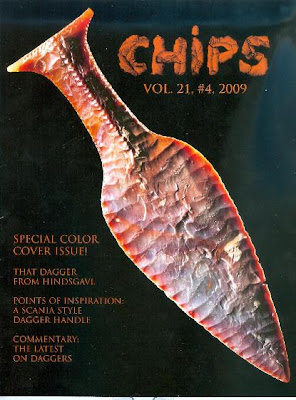
| FRONT COVER BY RAY AND BRYAN HARWOOD. ED MOSHER DAGGER.FROM RAY'S DANISH DAGGER ICE FISHING EXPERIMENTS. |
AMERICAN TYPE IV
DANISH DAGGER MASTERS
 |
| ED MOSHER DAGGERS |
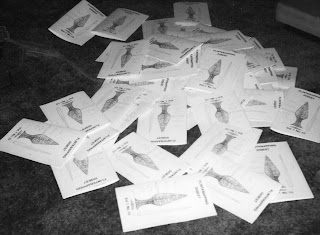
The classic Danish Dagger style is the type IV, with the leaf blade and incorporated squared off and stitched handle. The Neolithic Period, “Hindsgavl” Dagger, in the National Museum in Denmark is of this sort. According to the National Museum in Denmark “the daggers were prestige objects and do not seem to be usable for everyday activities”. Here are some authentic Danish Daggers Link: https://youtu.be/a3HvgMbgRWY
"In the Neolithic period the flintworkers achieved very high technical standards. The magnificent dagger from Hindsgavl with its blade less than 1 cm thick is the finest example of the flintworkers’ outstanding skills at the end of the Stone Age. It was found around 1876 on tihe island Fænø in the Little Belt. The dagger type is called a ‘fishtail dagger’ because of the fishtail-formed hilt. Pressure-flaked daggers mark the beginning of the end of the Stone Age, and are the reason why the period from 2400-1800 BC is called the Dagger Period."
-Danish National Museum
Anytime an archaeologist labels an artifact ritualistic,
ceremonial or a prestige item I always get suspicious. This leads to curiosity and often
experimentation. The first step in my
Danish Dagger experiment is to procure a task set of Danish Daggers, Ed Mosher,
of Monticello, Indiana is one of the
ever growing Number of modern flintknappers that produce excellent knapped replicas of this amazingly well-crafted flint artifact
type. I contacted and purchased several type IV daggers from Ed. I supplied Ed
with Glass Buttes obsidian for this big mutha, silver sheen. I used that in my
article on deer butchering with a type IV Danish Dagger. Mr Mosher knapped the
front cover dagger out of Peoria flint, photo by Ray and Bryan Harwood. These dagger experiments will be published, hopefully in a serries of furure articles in Knapper's Quarterly, PSK website and this blog.
Ed Mosher told
me in an interview (2013) that he
had had been flintknapping in the biface
tradition for many years before he had a Danish dagger epiphany. Like a Native American vision, the exact
dagger replication code came to Mr. Mosher in a dream.
“As for the daggers. I watched Mike Stafford make a
small dagger back around 91 and I watched every flake removal. I never tried to
make till about 3 years ago.”
Within days he was a
dagger master. Mr. Mosher began flintknapping at the very early age 10 years
old after being exposed to stone tools and arrowheads that had been collected
by his grandparents. Ed Mosher is a 2013 inductee of the “Flintknapping Hall of
Fame”. Here is the YouTube film of Ed making a Danish Dagger: https://youtu.be/273hqNzkhWw and https://youtu.be/0fBYSIszKFE
http://en.natmus.dk/historical-knowledge/denmark/prehistoric-period-until-1050-ad/the-neolithic-period/the-hindsgavl-dagger/
see above link.
Other American knappers that have become “dagger masters” of
sorts are scattered around the country.
Casting lab dagger Link:
http:/2002septemberdanishdaggerpage1/lithiccastinglab.com/gallery-pages/.htm


Callahan Flintknapper

THE ULTIMATE DAGGER FLINTKNAPPER.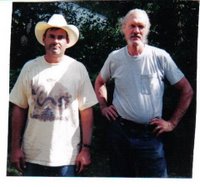
ERRETT CALLAHANBy: Ray Harwood
HARWOOD CALLAHAN
The Thinking Man: One of the most knowledgeable and talented
flintknappers of our time was a Virginia Flintknapper, whom has
influenced hundreds, if not thousands, Errett Callahan. We can sit
and wonder where Callahan came from and why he was such an influence.
The answer is this, Callahan came into knapping with a great deal of
skill, intellegence and strength, at a time when a whole new
generation of archaeologists were coming out of the old school with a
lot of questions. Crabtree had just released his book and was bumping
out students by the bus load. Archaeology was hungry and Callahan was
just what the doctor ordered. He had fresh ideas and an uncanning
knapping ability intertwined the craft and theory like no one before
or since.
In 1956, just out of high school, Errett spent the summer in
Yellowstone National Park working at the Old Faithful general store.
He was exposed to a lot of history at the park and had access to
obsidian, this gave him the start he needed and he began knapping
seriously then and has been doing it full steam ever since, later
combining his early grinding methods as part of his flaking strategy.
It started on a trip out when he was waiting for the train in
Montana. He went into a local library and found a book on various
point types. He was fascinated by this and it sort of plugged some
into his memory. In his spare time he would try to duplicate these,
using small pieces of obsidian and bottle glass and guided only by
the flintknapping picture in Holling's book. It was another 10 years
before Errett realized that there were other people flintknapping. Up
until then he thought he was the only one.
Errett read more and more of Bordes's works and met him several
times. Francois Bordes stayed at Callahan's house for several days in
1977. Bordes, as Errett, was inspired by Edgar Rice Burroughs and he
published numerous science fiction novels. Callahan, as a college
student, had once been assigned to be Bordes's escort to a knapping
demonstration sponsored by the Anthropology department in D.C. for
the Leaky Foundation lectures. In 1977 Bordes spent four days
knapping there in Richmond. Bordes had plenty of money to visit the
U.S.A. because not only was he a master flintknapper and Europe's
leading archaeologist, but also one of the most popular science
fiction writers in France. According to Callahan Bordes wrote dozens
of novels under the pen name of Franci Carsac. Callahan was
influenced quite a bit by Bordes. At the same time Errett was also
reading the works of Don Crabtree. Errett was Fascinated by Crabtree,
they met in Calgary in 1974 and Crabtree gradually became a heavy
influence on Errett's knapping. J.B. Sollberger was another major
influence and led Errett to bigger and better things than he could
have without that input. Gene Titmus of Idaho, a friend of Crabtree
was also a major influence on Callahan, mostly his notching and
serrating techniques. Errett stayed in close contact with Gene for
many years, Gene a master knapper of percussion and, like Don, about
the nicest and humblest guy he'd ever met.
Some other overseas influences on Errett were Jacques Pelegrin and Bo
Madsen. Pelegrin had been Bordes number one student in France,
working under him for years. Pelgrin first trained with Bordes over
six summers, for three weeks each summer. Pelegrin worked with a
hardwood billit, which he learned to use from Bordes's friend in
Paris, Jacques Tixier, whom was one of the Masters of flintworking of
the time. Pelegrin became very good with boxwood. Jacques Pelegrin's
father built a cottage in the French woods, here Jacques reflected on
archaeological concepts and flintknapping. At this time, in the
1970s, Pilegrin was writing a bit back and forth to Master Don
Crabtree in the USA and Jacques had begun to read and interprit
Crabtree's publications. Pelegrin did public flintknapping
demonstations in the Archeodrome, which is on the main road between
Beaune and Lyon, France. He is concidered one of the best
flintknappers in the world. Pelegrin and Bordes learned English
together and spend years flintknapping together and learning, master
and student became knapping partners. Jacques Pelgrin went through
almost all the Paleolthic French technologies while learning his
craft- Levallois, blade making, different kinds of Paleolithic tools,
different kinds of flint cores, and leave points, including Solutrean
pressure material. It is an interesting fact that Pelegrin learned to
flintknap standing up and only changes after his first exposure to
other knappers and text.
Bo Madsen is Denmark's premier flintknapper, a grand- master of the
Danish art. Madison is an expert on Danish lithics and earned his
Ph.D. at Arhus in Jutland, Denmark. Madsen's dagger research
influenced Callahan greatly and this spread to America and in this
era many knappers were attempting dagger production: Waldorf, Patten,
Stafford, Flenniken and Callahan in particular. Errett spend a good
deal of time in the 1970s in Scandinavia and returned again in August
of 1984. Madsen had moved over to the University of Arhus and was
teaching a talented portage, Peter Vemming Hansenat at the University
of Copenhagen, the two had co-wrote and published a paper on the
replication of square- sectioned axes. While in Scandinavia Callahan
gave several flintknapping workshops sponsored by the Archaeological
Institute of the University of Uppsala, Sweden, he was assisted by Bo
Madsen and Dr. Debbie Olausson. According to Callahan, the Copenhagen
area has several talented non-academic knappers as well Thorbjorn
Peterson, Asel Jorgensen, and Soren Moses.
In later years Errett's biggest influence was Richard Warren. Richard
was completely underground and out of contact for most of his
knapping life, he became a lapidary knapper that had an exclusive
clientele. Richard Warren's work was incredibly precise, much more
than anyone at the time thought was possible. Errett had to
reconstruct the Warren technique entirely from scratch. Richard
Warren showed Errett one important thing- perfection is possible- and
that's all he needed to know. Richard Warren died a few years ago,
Warren's curiosity was to know what could be done with flint if
someone picks up where the best stone age knappers abandoned the
craft for metal technology or extinction. In short Richard's quest
was for knapping for the sake of art-perfection, by any means
possible. Richard used the term "Teleolithics" to describe what we
now call lapidary knapping, flake over grinding (lap-knapping). After
Hannus' colon operation, in 1983, for which Errett made the obsidian
blades used in the surgery and observed the entire operation, two of
Callahan's students decided to start a company with him to market
these blades to the medical community. The one who was supposed to do
the marketing dropped out and little became of " Aztecnics".
Errett markets his obsidian art through "Piltdown Productions" in
Virginia. Callahan is best known for his published work The Basics Of
Biface Knapping In The Eastern Fluted Point Tradition A Manual For
Flintknappers And Lithic Analysts. This was published in Archaeology
Of North America, . He has also published many other books and
articles. Including: "Flintknappers' exchange" (the original
journal), "The Emic Perspective" and "Flintknapping Digest". The
Basics Of Biface knapping In The Eastern Fluted Point Tradition was
the single most influential lithic book ever written.
The Callahan biface book is Vol. 7, No. 1 of the journal Archaeology
Of Eastern North America. The book introduced many new techniques for
the study of stone tools, for standard and experimental archaeology.
The concepts, "the lithic grade scale, and biface staging, are widely
used in flintknapping circles to the point the most new knappers
didn't even know these concepts were fairly new and discovered by
Callahan.
As Crabtree before him Callahan was the only living flintknapper with
the confidence to have major surgery done with stone tools he crafted
himself. According to the news release on December 9th, 1998, Errett
Callahan had major surgery done to repair his right rotator cuff
tendon. The two hour landmark operation was done by Dr. Jay Hopkins
of Blue Ridge Orthopedics at Lynchburg General Hospital. Callahan's
rotor cuff tendon had become completely torn off the top of his
humerus bone and had to be extensively reworked. Dr Hopkins said that
it was as bad a tear as he had ever witnessed. All incisions were
made with Callahan's obsidian scalpels. Dr. Hopkins, after performing
the operation, was impressed with the great reduction of bleeding in
the initial incisions and states: I used the obsidian blade for a
shoulder operation and found them quite satisfactory. They performed
very much like a scalpel and the bleeding with the first cut through
the skin was minimal. Healing appears to be very much normal, if not
accelerated.
Errett Callahan was founder and president of the Society of Primitive
Technology for many years . The Society is an international
organization devoted to the preservation of a wide range of primitive
technologies. The SPT preserves and promotes this knowledge
principally by means of a remarkable magazine, the Bulletin of
Primitive Technology. Errett has now retired from his editor and
chief and president but he will stay an active member. For more
information contact Society of Primitive Technology, P.O. Box 905,
Rexburg, Id 83440. The Bulletin is now being edited and produced by
Primitive skills expert David Wescott. At this time Errett Callahan
is in the midst of writing a major book on flintknapping - everything
he knows...and he knows a lot..The book is going to focus a on Danish
Daggers. The book is addressed to both the archaeologist and
flintknapper a like. This book is a 20-year research project in which
200 daggers were replicated. The research was funded by a grant from
the King of Sweden and by Uppsala University. Callahan is cowritting
the book with Jan Apel, a PhD student at Uppsala and fellow
flintknapper. The new book will do for daggers what his biface book
did for that field. Callahan is also working on a book on
experimental archaeology.
Callahan still puts on his week long classes at Cliff Side on
flintknapping, traditional archery, primitive pottery, lithic
analysis, and more. Bob Verrey, a former student and long time
flintknapper, archaeologist and supplier of knapping tools offers a
scholarship to the school but it is very competitive. .
http://cart.occpaleo.com/vol1theflintdaggersofdenmark.aspx
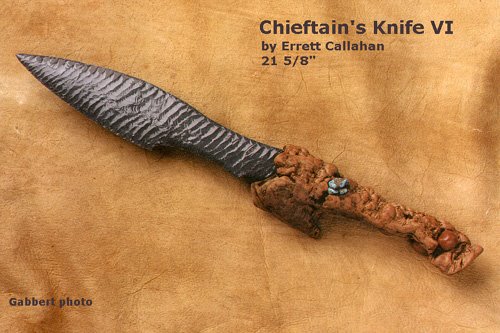
THE ULTIMATE DAGGER FLINTKNAPPER.
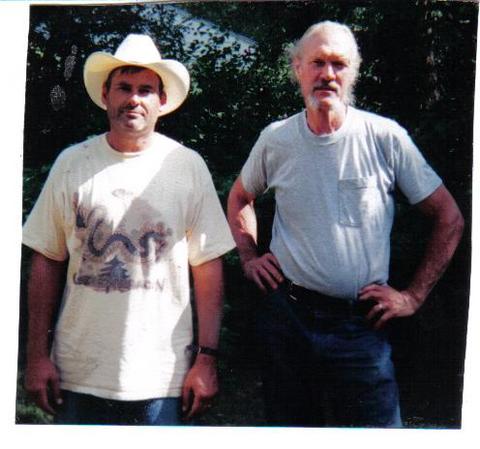
ERRETT CALLAHANBy: Ray Harwood
HARWOOD CALLAHAN
The Thinking Man: One of the most knowledgeable and talented
flintknappers of our time was a Virginia Flintknapper, whom has
influenced hundreds, if not thousands, Errett Callahan. We can sit
and wonder where Callahan came from and why he was such an influence.
The answer is this, Callahan came into knapping with a great deal of
skill, intellegence and strength, at a time when a whole new
generation of archaeologists were coming out of the old school with a
lot of questions. Crabtree had just released his book and was bumping
out students by the bus load. Archaeology was hungry and Callahan was
just what the doctor ordered. He had fresh ideas and an uncanning
knapping ability intertwined the craft and theory like no one before
or since.
In 1956, just out of high school, Errett spent the summer in
Yellowstone National Park working at the Old Faithful general store.
He was exposed to a lot of history at the park and had access to
obsidian, this gave him the start he needed and he began knapping
seriously then and has been doing it full steam ever since, later
combining his early grinding methods as part of his flaking strategy.
It started on a trip out when he was waiting for the train in
Montana. He went into a local library and found a book on various
point types. He was fascinated by this and it sort of plugged some
into his memory. In his spare time he would try to duplicate these,
using small pieces of obsidian and bottle glass and guided only by
the flintknapping picture in Holling's book. It was another 10 years
before Errett realized that there were other people flintknapping. Up
until then he thought he was the only one.
Errett read more and more of Bordes's works and met him several
times. Francois Bordes stayed at Callahan's house for several days in
1977. Bordes, as Errett, was inspired by Edgar Rice Burroughs and he
published numerous science fiction novels. Callahan, as a college
student, had once been assigned to be Bordes's escort to a knapping
demonstration sponsored by the Anthropology department in D.C. for
the Leaky Foundation lectures. In 1977 Bordes spent four days
knapping there in Richmond. Bordes had plenty of money to visit the
U.S.A. because not only was he a master flintknapper and Europe's
leading archaeologist, but also one of the most popular science
fiction writers in France. According to Callahan Bordes wrote dozens
of novels under the pen name of Franci Carsac. Callahan was
influenced quite a bit by Bordes. At the same time Errett was also
reading the works of Don Crabtree. Errett was Fascinated by Crabtree,
they met in Calgary in 1974 and Crabtree gradually became a heavy
influence on Errett's knapping. J.B. Sollberger was another major
influence and led Errett to bigger and better things than he could
have without that input. Gene Titmus of Idaho, a friend of Crabtree
was also a major influence on Callahan, mostly his notching and
serrating techniques. Errett stayed in close contact with Gene for
many years, Gene a master knapper of percussion and, like Don, about
the nicest and humblest guy he'd ever met.
Some other overseas influences on Errett were Jacques Pelegrin and Bo
Madsen. Pelegrin had been Bordes number one student in France,
working under him for years. Pelgrin first trained with Bordes over
six summers, for three weeks each summer. Pelegrin worked with a
hardwood billit, which he learned to use from Bordes's friend in
Paris, Jacques Tixier, whom was one of the Masters of flintworking of
the time. Pelegrin became very good with boxwood. Jacques Pelegrin's
father built a cottage in the French woods, here Jacques reflected on
archaeological concepts and flintknapping. At this time, in the
1970s, Pilegrin was writing a bit back and forth to Master Don
Crabtree in the USA and Jacques had begun to read and interprit
Crabtree's publications. Pelegrin did public flintknapping
demonstations in the Archeodrome, which is on the main road between
Beaune and Lyon, France. He is concidered one of the best
flintknappers in the world. Pelegrin and Bordes learned English
together and spend years flintknapping together and learning, master
and student became knapping partners. Jacques Pelgrin went through
almost all the Paleolthic French technologies while learning his
craft- Levallois, blade making, different kinds of Paleolithic tools,
different kinds of flint cores, and leave points, including Solutrean
pressure material. It is an interesting fact that Pelegrin learned to
flintknap standing up and only changes after his first exposure to
other knappers and text.
Bo Madsen is Denmark's premier flintknapper, a grand- master of the
Danish art. Madison is an expert on Danish lithics and earned his
Ph.D. at Arhus in Jutland, Denmark. Madsen's dagger research
influenced Callahan greatly and this spread to America and in this
era many knappers were attempting dagger production: Waldorf, Patten,
Stafford, Flenniken and Callahan in particular. Errett spend a good
deal of time in the 1970s in Scandinavia and returned again in August
of 1984. Madsen had moved over to the University of Arhus and was
teaching a talented portage, Peter Vemming Hansenat at the University
of Copenhagen, the two had co-wrote and published a paper on the
replication of square- sectioned axes. While in Scandinavia Callahan
gave several flintknapping workshops sponsored by the Archaeological
Institute of the University of Uppsala, Sweden, he was assisted by Bo
Madsen and Dr. Debbie Olausson. According to Callahan, the Copenhagen
area has several talented non-academic knappers as well Thorbjorn
Peterson, Asel Jorgensen, and Soren Moses.
In later years Errett's biggest influence was Richard Warren. Richard
was completely underground and out of contact for most of his
knapping life, he became a lapidary knapper that had an exclusive
clientele. Richard Warren's work was incredibly precise, much more
than anyone at the time thought was possible. Errett had to
reconstruct the Warren technique entirely from scratch. Richard
Warren showed Errett one important thing- perfection is possible- and
that's all he needed to know. Richard Warren died a few years ago,
Warren's curiosity was to know what could be done with flint if
someone picks up where the best stone age knappers abandoned the
craft for metal technology or extinction. In short Richard's quest
was for knapping for the sake of art-perfection, by any means
possible. Richard used the term "Teleolithics" to describe what we
now call lapidary knapping, flake over grinding (lap-knapping). After
Hannus' colon operation, in 1983, for which Errett made the obsidian
blades used in the surgery and observed the entire operation, two of
Callahan's students decided to start a company with him to market
these blades to the medical community. The one who was supposed to do
the marketing dropped out and little became of " Aztecnics".
Errett markets his obsidian art through "Piltdown Productions" in
Virginia. Callahan is best known for his published work The Basics Of
Biface Knapping In The Eastern Fluted Point Tradition A Manual For
Flintknappers And Lithic Analysts. This was published in Archaeology
Of North America, . He has also published many other books and
articles. Including: "Flintknappers' exchange" (the original
journal), "The Emic Perspective" and "Flintknapping Digest". The
Basics Of Biface knapping In The Eastern Fluted Point Tradition was
the single most influential lithic book ever written.
The Callahan biface book is Vol. 7, No. 1 of the journal Archaeology
Of Eastern North America. The book introduced many new techniques for
the study of stone tools, for standard and experimental archaeology.
The concepts, "the lithic grade scale, and biface staging, are widely
used in flintknapping circles to the point the most new knappers
didn't even know these concepts were fairly new and discovered by
Callahan.
As Crabtree before him Callahan was the only living flintknapper with
the confidence to have major surgery done with stone tools he crafted
himself. According to the news release on December 9th, 1998, Errett
Callahan had major surgery done to repair his right rotator cuff
tendon. The two hour landmark operation was done by Dr. Jay Hopkins
of Blue Ridge Orthopedics at Lynchburg General Hospital. Callahan's
rotor cuff tendon had become completely torn off the top of his
humerus bone and had to be extensively reworked. Dr Hopkins said that
it was as bad a tear as he had ever witnessed. All incisions were
made with Callahan's obsidian scalpels. Dr. Hopkins, after performing
the operation, was impressed with the great reduction of bleeding in
the initial incisions and states: I used the obsidian blade for a
shoulder operation and found them quite satisfactory. They performed
very much like a scalpel and the bleeding with the first cut through
the skin was minimal. Healing appears to be very much normal, if not
accelerated.
Errett Callahan was founder and president of the Society of Primitive
Technology for many years . The Society is an international
organization devoted to the preservation of a wide range of primitive
technologies. The SPT preserves and promotes this knowledge
principally by means of a remarkable magazine, the Bulletin of
Primitive Technology. Errett has now retired from his editor and
chief and president but he will stay an active member. For more
information contact Society of Primitive Technology, P.O. Box 905,
Rexburg, Id 83440. The Bulletin is now being edited and produced by
Primitive skills expert David Wescott. At this time Errett Callahan
is in the midst of writing a major book on flintknapping - everything
he knows...and he knows a lot..The book is going to focus a on Danish
Daggers. The book is addressed to both the archaeologist and
flintknapper a like. This book is a 20-year research project in which
200 daggers were replicated. The research was funded by a grant from
the King of Sweden and by Uppsala University. Callahan is cowritting
the book with Jan Apel, a PhD student at Uppsala and fellow
flintknapper. The new book will do for daggers what his biface book
did for that field. Callahan is also working on a book on
experimental archaeology.
Callahan still puts on his week long classes at Cliff Side on
flintknapping, traditional archery, primitive pottery, lithic
analysis, and more. Bob Verrey, a former student and long time
flintknapper, archaeologist and supplier of knapping tools offers a
scholarship to the school but it is very competitive. .
flintknappers of our time was a Virginia Flintknapper, whom has
influenced hundreds, if not thousands, Errett Callahan. We can sit
and wonder where Callahan came from and why he was such an influence.
The answer is this, Callahan came into knapping with a great deal of
skill, intellegence and strength, at a time when a whole new
generation of archaeologists were coming out of the old school with a
lot of questions. Crabtree had just released his book and was bumping
out students by the bus load. Archaeology was hungry and Callahan was
just what the doctor ordered. He had fresh ideas and an uncanning
knapping ability intertwined the craft and theory like no one before
or since.
In 1956, just out of high school, Errett spent the summer in
Yellowstone National Park working at the Old Faithful general store.
He was exposed to a lot of history at the park and had access to
obsidian, this gave him the start he needed and he began knapping
seriously then and has been doing it full steam ever since, later
combining his early grinding methods as part of his flaking strategy.
It started on a trip out when he was waiting for the train in
Montana. He went into a local library and found a book on various
point types. He was fascinated by this and it sort of plugged some
into his memory. In his spare time he would try to duplicate these,
using small pieces of obsidian and bottle glass and guided only by
the flintknapping picture in Holling's book. It was another 10 years
before Errett realized that there were other people flintknapping. Up
until then he thought he was the only one.
Errett read more and more of Bordes's works and met him several
times. Francois Bordes stayed at Callahan's house for several days in
1977. Bordes, as Errett, was inspired by Edgar Rice Burroughs and he
published numerous science fiction novels. Callahan, as a college
student, had once been assigned to be Bordes's escort to a knapping
demonstration sponsored by the Anthropology department in D.C. for
the Leaky Foundation lectures. In 1977 Bordes spent four days
knapping there in Richmond. Bordes had plenty of money to visit the
U.S.A. because not only was he a master flintknapper and Europe's
leading archaeologist, but also one of the most popular science
fiction writers in France. According to Callahan Bordes wrote dozens
of novels under the pen name of Franci Carsac. Callahan was
influenced quite a bit by Bordes. At the same time Errett was also
reading the works of Don Crabtree. Errett was Fascinated by Crabtree,
they met in Calgary in 1974 and Crabtree gradually became a heavy
influence on Errett's knapping. J.B. Sollberger was another major
influence and led Errett to bigger and better things than he could
have without that input. Gene Titmus of Idaho, a friend of Crabtree
was also a major influence on Callahan, mostly his notching and
serrating techniques. Errett stayed in close contact with Gene for
many years, Gene a master knapper of percussion and, like Don, about
the nicest and humblest guy he'd ever met.
Some other overseas influences on Errett were Jacques Pelegrin and Bo
Madsen. Pelegrin had been Bordes number one student in France,
working under him for years. Pelgrin first trained with Bordes over
six summers, for three weeks each summer. Pelegrin worked with a
hardwood billit, which he learned to use from Bordes's friend in
Paris, Jacques Tixier, whom was one of the Masters of flintworking of
the time. Pelegrin became very good with boxwood. Jacques Pelegrin's
father built a cottage in the French woods, here Jacques reflected on
archaeological concepts and flintknapping. At this time, in the
1970s, Pilegrin was writing a bit back and forth to Master Don
Crabtree in the USA and Jacques had begun to read and interprit
Crabtree's publications. Pelegrin did public flintknapping
demonstations in the Archeodrome, which is on the main road between
Beaune and Lyon, France. He is concidered one of the best
flintknappers in the world. Pelegrin and Bordes learned English
together and spend years flintknapping together and learning, master
and student became knapping partners. Jacques Pelgrin went through
almost all the Paleolthic French technologies while learning his
craft- Levallois, blade making, different kinds of Paleolithic tools,
different kinds of flint cores, and leave points, including Solutrean
pressure material. It is an interesting fact that Pelegrin learned to
flintknap standing up and only changes after his first exposure to
other knappers and text.
Bo Madsen is Denmark's premier flintknapper, a grand- master of the
Danish art. Madison is an expert on Danish lithics and earned his
Ph.D. at Arhus in Jutland, Denmark. Madsen's dagger research
influenced Callahan greatly and this spread to America and in this
era many knappers were attempting dagger production: Waldorf, Patten,
Stafford, Flenniken and Callahan in particular. Errett spend a good
deal of time in the 1970s in Scandinavia and returned again in August
of 1984. Madsen had moved over to the University of Arhus and was
teaching a talented portage, Peter Vemming Hansenat at the University
of Copenhagen, the two had co-wrote and published a paper on the
replication of square- sectioned axes. While in Scandinavia Callahan
gave several flintknapping workshops sponsored by the Archaeological
Institute of the University of Uppsala, Sweden, he was assisted by Bo
Madsen and Dr. Debbie Olausson. According to Callahan, the Copenhagen
area has several talented non-academic knappers as well Thorbjorn
Peterson, Asel Jorgensen, and Soren Moses.
In later years Errett's biggest influence was Richard Warren. Richard
was completely underground and out of contact for most of his
knapping life, he became a lapidary knapper that had an exclusive
clientele. Richard Warren's work was incredibly precise, much more
than anyone at the time thought was possible. Errett had to
reconstruct the Warren technique entirely from scratch. Richard
Warren showed Errett one important thing- perfection is possible- and
that's all he needed to know. Richard Warren died a few years ago,
Warren's curiosity was to know what could be done with flint if
someone picks up where the best stone age knappers abandoned the
craft for metal technology or extinction. In short Richard's quest
was for knapping for the sake of art-perfection, by any means
possible. Richard used the term "Teleolithics" to describe what we
now call lapidary knapping, flake over grinding (lap-knapping). After
Hannus' colon operation, in 1983, for which Errett made the obsidian
blades used in the surgery and observed the entire operation, two of
Callahan's students decided to start a company with him to market
these blades to the medical community. The one who was supposed to do
the marketing dropped out and little became of " Aztecnics".
Errett markets his obsidian art through "Piltdown Productions" in
Virginia. Callahan is best known for his published work The Basics Of
Biface Knapping In The Eastern Fluted Point Tradition A Manual For
Flintknappers And Lithic Analysts. This was published in Archaeology
Of North America, . He has also published many other books and
articles. Including: "Flintknappers' exchange" (the original
journal), "The Emic Perspective" and "Flintknapping Digest". The
Basics Of Biface knapping In The Eastern Fluted Point Tradition was
the single most influential lithic book ever written.
The Callahan biface book is Vol. 7, No. 1 of the journal Archaeology
Of Eastern North America. The book introduced many new techniques for
the study of stone tools, for standard and experimental archaeology.
The concepts, "the lithic grade scale, and biface staging, are widely
used in flintknapping circles to the point the most new knappers
didn't even know these concepts were fairly new and discovered by
Callahan.
As Crabtree before him Callahan was the only living flintknapper with
the confidence to have major surgery done with stone tools he crafted
himself. According to the news release on December 9th, 1998, Errett
Callahan had major surgery done to repair his right rotator cuff
tendon. The two hour landmark operation was done by Dr. Jay Hopkins
of Blue Ridge Orthopedics at Lynchburg General Hospital. Callahan's
rotor cuff tendon had become completely torn off the top of his
humerus bone and had to be extensively reworked. Dr Hopkins said that
it was as bad a tear as he had ever witnessed. All incisions were
made with Callahan's obsidian scalpels. Dr. Hopkins, after performing
the operation, was impressed with the great reduction of bleeding in
the initial incisions and states: I used the obsidian blade for a
shoulder operation and found them quite satisfactory. They performed
very much like a scalpel and the bleeding with the first cut through
the skin was minimal. Healing appears to be very much normal, if not
accelerated.
Errett Callahan was founder and president of the Society of Primitive
Technology for many years . The Society is an international
organization devoted to the preservation of a wide range of primitive
technologies. The SPT preserves and promotes this knowledge
principally by means of a remarkable magazine, the Bulletin of
Primitive Technology. Errett has now retired from his editor and
chief and president but he will stay an active member. For more
information contact Society of Primitive Technology, P.O. Box 905,
Rexburg, Id 83440. The Bulletin is now being edited and produced by
Primitive skills expert David Wescott. At this time Errett Callahan
is in the midst of writing a major book on flintknapping - everything
he knows...and he knows a lot..The book is going to focus a on Danish
Daggers. The book is addressed to both the archaeologist and
flintknapper a like. This book is a 20-year research project in which
200 daggers were replicated. The research was funded by a grant from
the King of Sweden and by Uppsala University. Callahan is cowritting
the book with Jan Apel, a PhD student at Uppsala and fellow
flintknapper. The new book will do for daggers what his biface book
did for that field. Callahan is also working on a book on
experimental archaeology.
Callahan still puts on his week long classes at Cliff Side on
flintknapping, traditional archery, primitive pottery, lithic
analysis, and more. Bob Verrey, a former student and long time
flintknapper, archaeologist and supplier of knapping tools offers a
scholarship to the school but it is very competitive. .
| ||
 Dr Errett Callahan of Virginia was one of the first of the
American knappers to crack the “dagger code”
Dr Errett Callahan of Virginia was one of the first of the
American knappers to crack the “dagger code”
Errett Callahan was founder and president of the Society of
Primitive Technology for many years . The Society is an international
organization devoted to the preservation of a wide range of primitive
technologies. The SPT preserves and promotes this knowledge principally by
means of a remarkable magazine, the Bulletin of Primitive Technology
he one who was supposed to do the marketing dropped out and
little became of " Aztecnics”. Errett markets his obsidian art through
"Piltdown Productions" in Virginia. Callahan is best known for his
published work The Basics Of Biface Knapping In The Eastern Fluted Point
Tradition A Manual For Flintknappers And Lithic Analysts. This was published in
Archaeology Of North America, . He has also published many other books and
articles. Including: "Flintknappers' exchange" (the original
journal), "The Emic Perspective" and "Flintknapping
Digest". The Basics Of Biface knapping In The Eastern Fluted Point
Tradition was the single most influential lithic book ever written. The
Callahan biface book is Vol. 7, No. 1 of the journal Archaeology Of Eastern
North America. The book introduced mahe one who was supposed to do the
marketing dropped out and little became of " Aztecnics”. Errett markets
his obsidian art through "Piltdown Productions" in Virginia. Callahan
is best known for his published work The Basics Of Biface Knapping In The
Eastern Fluted Point Tradition A Manual For Flintknappers And Lithic Analysts.
This was published in Archaeology Of North America, . He has also published
many other books and articles. Including: "Flintknappers' exchange"
(the original journal), "The Emic Perspective" and
"Flintknapping Digest". The Basics Of Biface knapping In The Eastern
Fluted Point Tradition was the single most influential lithic book ever
written. The Callahan biface book is Vol. 7, No. 1 of the journal Archaeology
Of Eastern North America. The book introduced many new techniques for the study
of stone tools, for standard and experimental archaeology. The concepts,
"the lithic grade scale, and biface staging, are widely used in
flintknapping circles to the point the most new knappers didn't even know these
concepts were fairly new and discovered by Callahan.
ny new techniques for the study of stone tools, for standard
and experimental archaeology. The concepts, "the lithic grade scale, and
biface staging, are widely used in flintknapping circles to the point the most
new knappers didn't even know these concepts were fairly new and discovered by
Callahan.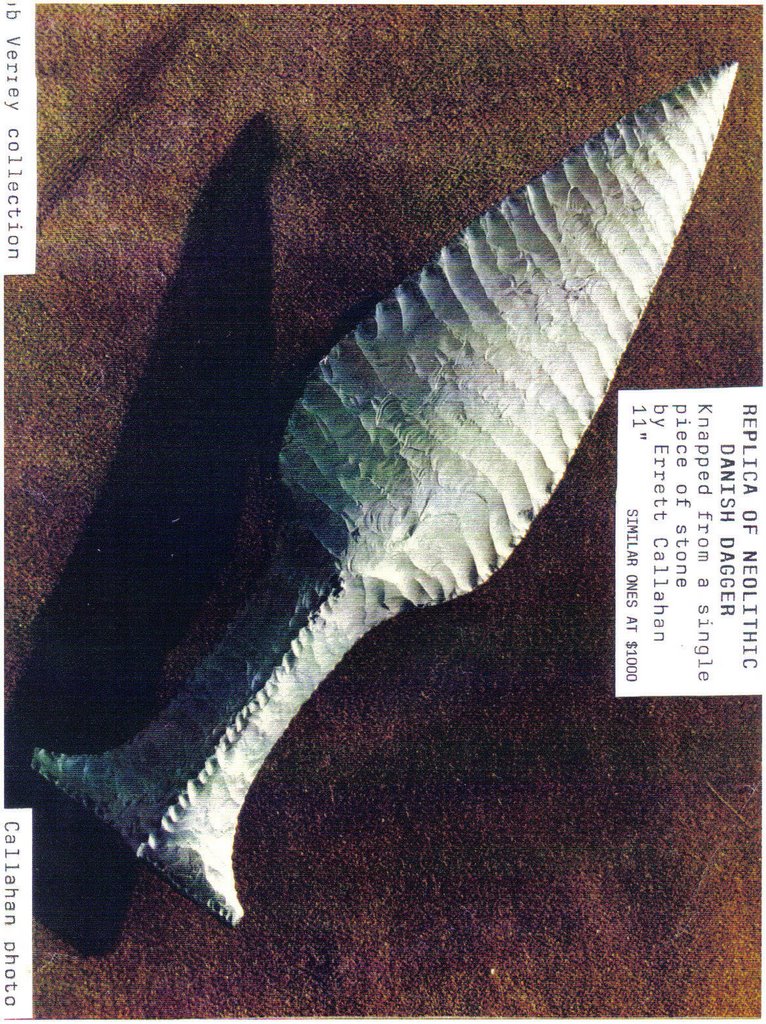
4. Selected References (books and some other important
published work [not everything])
CALLAHAN, E., The Basics Of Biface Knapping In The Eastern
Fluted Point Tradition: A Manual For Flintknappers And Lithic Analysts, , 4th
edition, 2000.
CALLAHAN, E., "Experiments with Danish mesolithic
microblade technology", Bulletin of Primitive Technology, vol. 20, Utah,
Society of Primitive Technology, pp. 62-68, 2000.
5. External Links (Wikipedia and other sites)
Mike Stafford Ph.D. in anthropology, specialty
in the prehistory of Denmark and the American Great Lakes; Lithic technology
and flint working; Museum science
Activities and
Societies: Fulbright Scholar/Denmark. Danish
dagger student of Dr. Errett
Callahan when he
was giving classes at his Cliffside flintknapping Skills School. I was told
that Dr. Stafford was responsible for bringing D.C Waldorf to Denmark for his research.
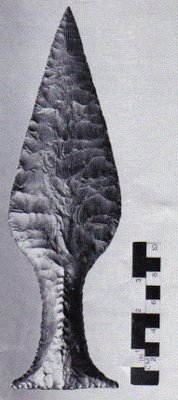
Stafford (1998) asked the question “Type IV daggers: the world’s most complex
stone tool form?” He describes the dagger form, categorized by Lomborg (1973),
as the most famous of the six letter-designated sub-types.
“Type IV”
daggers are Characterized by broad, leaf-shaped blades with tapering handles, a
squared base or “pommel”, and a pressure-flaked handle with a seam-like
appearance on the lateral handle margins and median. Some sub varieties have a
ground and pressure-flaked blade, resulting in the elegant parallel flake
patterns common to the earlier type Ic lanceolate
form. Lenticular transverse cross-sections are common on the type IV dagger
blades, and handles are either triangular or diamond-shaped in transverse
section. A rare sub variant, the type
IVf, has a square-section handle, much like that of a quadriface flint axe.” Mike
Stafford Ph.D (1998)
Link:
http://science.cranbrook.edu/sites/default/files/sdarticle.pdf
 D.C.
Waldorf was also an early American Dagger master influenced
hundreds, if not thousands, was one of the founding fathers of the Missouri
knapping style. When I was a kid I was very interested in arrowheads. I used to
find them once in a while when hunting with my dad and brother. Like many folks
dabbling in flintknapping I eventually came upon Waldorf's book, "Art of
Flintknapping". The books has sold many thousands of copies and is
considered a classic.
D.C.
Waldorf was also an early American Dagger master influenced
hundreds, if not thousands, was one of the founding fathers of the Missouri
knapping style. When I was a kid I was very interested in arrowheads. I used to
find them once in a while when hunting with my dad and brother. Like many folks
dabbling in flintknapping I eventually came upon Waldorf's book, "Art of
Flintknapping". The books has sold many thousands of copies and is
considered a classic.
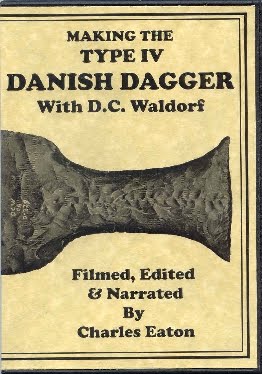
D.C. and his wife Val took over the "Flintknapping Digest",at my request, and turned it into "CHIPS" - this was a huge success. He also wrote many other books, including novels out of his rural Missouri cabin. D.C. and Val made a good living with "Mound Builder Books". Later D.C. Waldorf became one of the pioneers of the new Danish Dagger movement.
Waldorf Dagger Film link:
See also:
2007
D.C. Waldorf's Guide to the Flint Daggers of Southern Scandinavia and
North Germany. Mound Arts and Trading Co., Branson, MO.
Waldorf,
D. C.
1984 The
Art of Flintknapping. 3rd ed. Mound Arts and Trading Co., Branson, MO.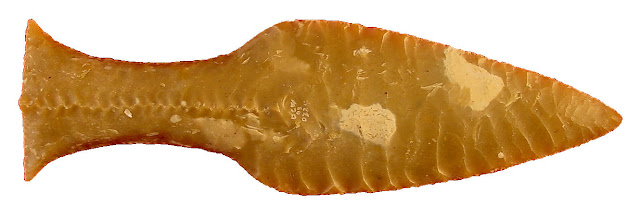
Courtesy of The Public Opinion - Watertown, South Dakota and the PSK
May 31 1963 - May 26 2014 |

 and I'll see that they get added!
DAGGER MONTH! By Emory Coons

They was a rock i chipped them out..... the end.....Lmao I always liked daggers and swords stone, metal, or ground out like the terracotta warrior's in china, they always held a fascination to me. each is individually done and even though there the same shape each has it's own unique feel and story. It is like i say a art not just a tool to be used for death and destruction. the angles challenge the artist when being made out of each stone.

If the blow to the edge is off the piece might be several and nothing more than dust on the pile of flakes for some lucky archaeologist in the future if we have one left. When i was younger i couldn't afford metal swords or blades so i made my own some with eagle heads on or the shape of it depending on if I was trying a design and the rock let me know what it was going to be or had the look of. there was no set plan and some just manifest out of the stone, sure it's nice to build something that no one else has tried or seen and that's why i love chipping rock because you never know they'll be around long, long after I'm gone and if they inspire the next great artist great it truly is the best feeling to know I here at this point and time to enjoy what I do.

If the blow to the edge is off the piece might be several and nothing more than dust on the pile of flakes for some lucky archaeologist in the future if we have one left. When i was younger i couldn't afford metal swords or blades so i made my own some with eagle heads on or the shape of it depending on if I was trying a design and the rock let me know what it was going to be or had the look of. there was no set plan and some just manifest out of the stone, sure it's nice to build something that no one else has tried or seen and that's why i love chipping rock because you never know they'll be around long, long after I'm gone and if they inspire the next great artist great it truly is the best feeling to know I here at this point and time to enjoy what I do.


"Emory
Coons ( By Ray Harwood) was born in Burns Oregon in 1971 and started flintknapping at the
age of five, 33 years ago. He has been on OPB on The Caveman at Glass Buttes
and Channel 2 News Boise Idaho about the Nyssa rock and gem show multiple
times. Several news paper articles have been written on his art from gem and
mineral shows he has attended in Nyssa Oregon, Burns Oregon, Madras Oregon, The
Dalles Oregon, Pendleton Oregon, Mission Oregon, Salem Oregon and the Oregonian
in Portland Oregon and Golden Dale Washington. The Pendleton Mission papers had
a mention for round-up as well as the blades he chipped were built into the
Umatilla Veterans’ Memorial. He has taught classes in flintknapping at Indian
Lake for the Umatilla tribe four years also the wild horse atl-atl
demonstration as well as Pipestone Creek Alberta Canada and in Medicine Hat
British Colombia Canada for the Jr. Forest Wardens, at Northern Lights out of
Slocan Canada twice, also demonstrated flintknapping along the Oregon Wagon
Train in 1993, Baker interruptive center, and Windows to the Past for the BLM
and Forest Service. Then there's knapp-ins (arrowhead makers conventions) at
Glass Buttes Oregon, Ed Thomas Golden Dale Washington knap-in, Richardson’s
rock ranch knap-in and the Brad Boughman- Jim Hopper Knapp-in on the upper
North Umqua .some of the worlds best knappers come to these events to show
there skills and teach. Emory attends gem and mineral shows like the
Confederated show in Onterio, Nyssa Thunder Egg Days, Prineville Oregon, Hines
Oregon Obsidian Days show his father started and the Madras, Oregon gem and
mineral show.Emory made the massive obsidian blade for the movie Reddick. He has the current world record biface, for a
living knapper. He crafts amazingly
notched eccentrics, including his amazing eagles. He has influenced at
least one generation of knappers."
. External Links
(Wikipedia and other)


 |
| RAY HARWOOD, BLOGGER: FLINTKNAPPING MAGAZINE figflint@yahoo.com |
https://www.facebook.com/groups/1460469140931238/


